
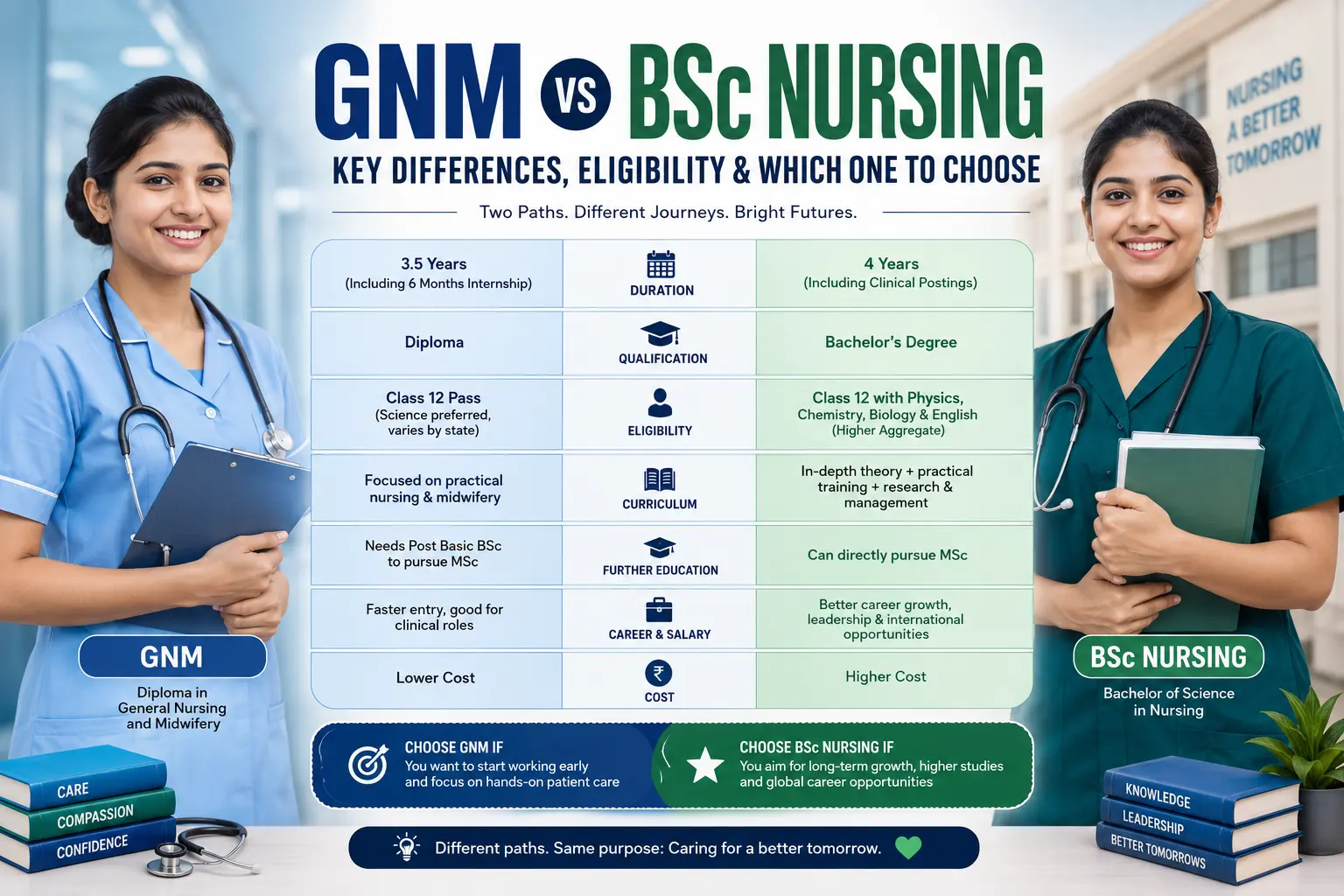
Every year, thousands of nursing aspirants get stuck on the same question: should I go for GNM or BSc Nursing? The two courses sound similar, lead to overlapping careers, and are often marketed the same way by colleges — but they differ in duration, depth, eligibility, and long-term career ceiling. Here’s a clear, side-by-side comparison to help you decide.
What Is GNM?
GNM (General Nursing and Midwifery) is a diploma-level nursing program, not a degree. It focuses on practical, hands-on nursing skills — general patient care, midwifery, and basic clinical procedures — with a shorter, more clinically intensive training path than a degree course.
What Is BSc Nursing?
BSc Nursing is a full undergraduate degree that covers the same core clinical training as GNM but goes further into nursing theory, research, pharmacology, community health, and nursing management, preparing graduates for both clinical and leadership roles.
GNM vs BSc Nursing: Side-by-Side Comparison
Duration
GNM is typically a 3.5-year program, including 6 months of internship. BSc Nursing is a 4-year degree program, including clinical postings integrated throughout the course.
Qualification Type
GNM is a diploma. BSc Nursing is a full bachelor’s degree, which matters significantly for further studies and international recognition.
Eligibility
GNM generally requires Class 12 pass (often with Science, though some states accept any stream) with a minimum aggregate that varies by state and institution. BSc Nursing requires Class 12 with Physics, Chemistry, Biology, and English, typically with a higher minimum aggregate than GNM.
Curriculum Depth
GNM focuses heavily on practical nursing and midwifery skills with a compressed theory component. BSc Nursing includes the same practical training plus in-depth theory in anatomy, physiology, pharmacology, nursing research, and healthcare management.
Further Education
This is where the two paths diverge most. BSc Nursing graduates can directly pursue an MSc Nursing. GNM diploma holders typically need to complete a Post Basic BSc Nursing (a bridge course) before they can pursue an MSc, adding time to their academic path if they want to move into teaching, research, or senior clinical leadership.
Career Scope and Salary
Both qualifications qualify graduates to work as registered nurses after passing the relevant state nursing council exam. However, BSc Nursing graduates generally have an edge in hospital hierarchies, tend to be preferred for supervisory and administrative nursing roles, and are more competitive candidates for international nursing opportunities in the Gulf, UK, and other regions that often expect a bachelor’s-level qualification.
Cost
GNM programs are generally more affordable and quicker to complete, making them an attractive option for students who want to start earning sooner. BSc Nursing has a higher upfront time and cost investment but tends to pay off over a longer career through better designation and growth opportunities.
Which One Should You Choose?
Choose GNM if you want to start working as a nurse as quickly as possible, are focused primarily on hands-on clinical care, or are working with a tighter budget and timeline.
Choose BSc Nursing if you’re aiming for long-term career growth, considering international opportunities, interested in nursing education or research eventually, or want a qualification that keeps postgraduate options open without needing a bridge course first.
Final Word
Neither path is objectively “better” — they serve different goals and timelines. What matters is being honest about whether you’re optimizing for how fast you enter the workforce or how far you want to climb over a full career. If you’re weighing this decision against your specific state’s eligibility rules, entrance requirements, and college options, it’s worth getting that mapped out properly before you commit.