
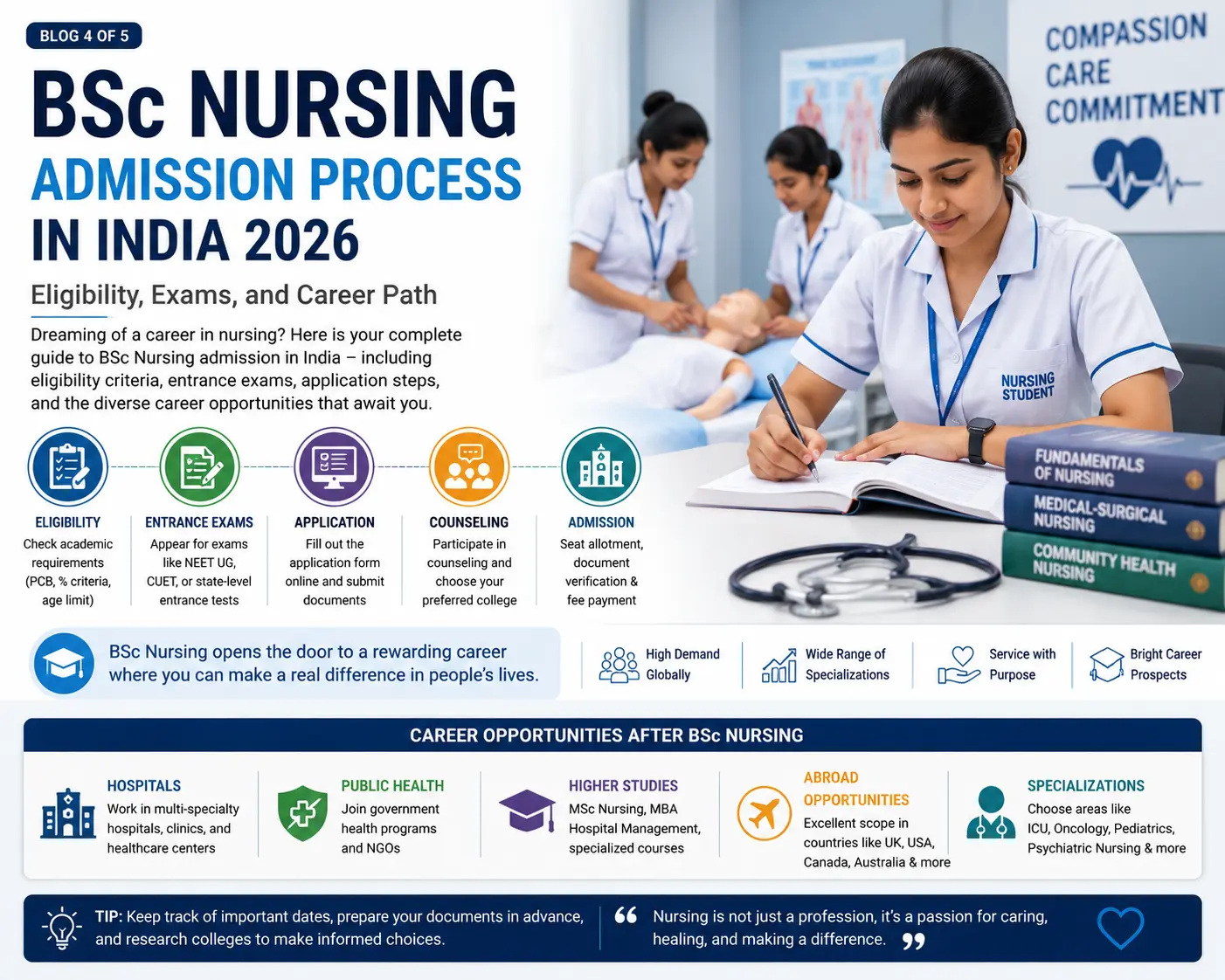
Nursing rarely gets the same spotlight as MBBS in career conversations, yet it is one of the most globally portable healthcare qualifications a student in India can earn. Hospitals worldwide face chronic nursing shortages, which means a BSc Nursing degree from a good institution can open doors from a local government hospital to an international healthcare system. Here’s how the admission process actually works.
What Is BSc Nursing?
BSc Nursing is a four-year undergraduate degree that trains students in patient care, clinical procedures, pharmacology, community health, and nursing management, preparing them to work as registered nurses across hospital, community, and specialized care settings.
Eligibility Criteria
- Candidates must have passed Physics, Chemistry, Biology, and English individually in Class 12.
- A minimum aggregate of 45% in PCB is generally required for General category candidates, with relaxed requirements (often around 40%) for SC/ST/OBC candidates, subject to the specific institution’s norms.
- Minimum age is typically 17 years as of December 31 of the admission year, with an upper age limit around 35 in many states — always verify this against your specific state or institution, as it varies.
- Candidates must be medically fit, since nursing involves sustained physical and clinical duties.
Entrance Exams: It Varies by State and Institution
Unlike MBBS, BSc Nursing admission is not governed by a single nationwide exam everywhere. The pathway depends heavily on your state and the type of institution:
- In several states, exams like KCET (Karnataka) or equivalent state-level common entrance tests are the primary route into government and many private nursing colleges.
- Many private institutions admit students directly based on Class 12 merit, without a separate entrance test.
- NEET is increasingly relevant for certain government-quota or central institution seats, and some states are gradually aligning nursing admissions closer to the NEET framework, though this is not yet uniform nationally.
Because this landscape genuinely varies by state and changes from year to year, the single most important step for any BSc Nursing aspirant is to check the specific requirement for their state and shortlisted colleges directly, rather than assuming one national rule applies everywhere.
Step-by-Step Admission Process
- Confirm your state’s specific entrance requirement — KCET, NEET, or direct merit-based admission.
- Apply within the window, typically opening between January and March, with exams conducted between April and June depending on the state.
- Submit your application online, usually through the state’s common entrance authority portal (such as KEA in Karnataka) or directly through the college’s own admission portal.
- Appear for the entrance exam, if applicable in your state.
- Participate in centralized or institutional counseling, filling your college and preferences based on rank, category, and seat availability.
- Confirm your seat by completing document verification and paying the admission fee.
Documents Required
Class 10 and 12 mark sheets, transfer certificate, migration certificate, a valid photo ID such as Aadhaar or passport, medical fitness certificate, character certificate, and category certificate where applicable for reservation benefits.
Career Scope After BSc Nursing
A BSc Nursing degree is a genuinely versatile qualification:
- Staff nurse or ICU nurse in government and private hospitals.
- Community health nurse, working in public health programs and rural healthcare.
- Military nursing service, a respected and stable government career path.
- Nursing education, teaching future nursing students after gaining sufficient clinical experience and further qualification.
- Healthcare administration, moving into hospital management roles over time.
- International nursing careers, with strong demand in the Gulf, UK, and other regions for qualified Indian nurses.
Final Word
Because BSc Nursing admission rules differ meaningfully by state and change year to year, don’t rely on general online information alone when you’re choosing your entrance route and shortlisting colleges. A quick verification against your specific state’s current-year notification — or a conversation with someone who tracks these changes closely — can save you from applying through the wrong channel entirely.