
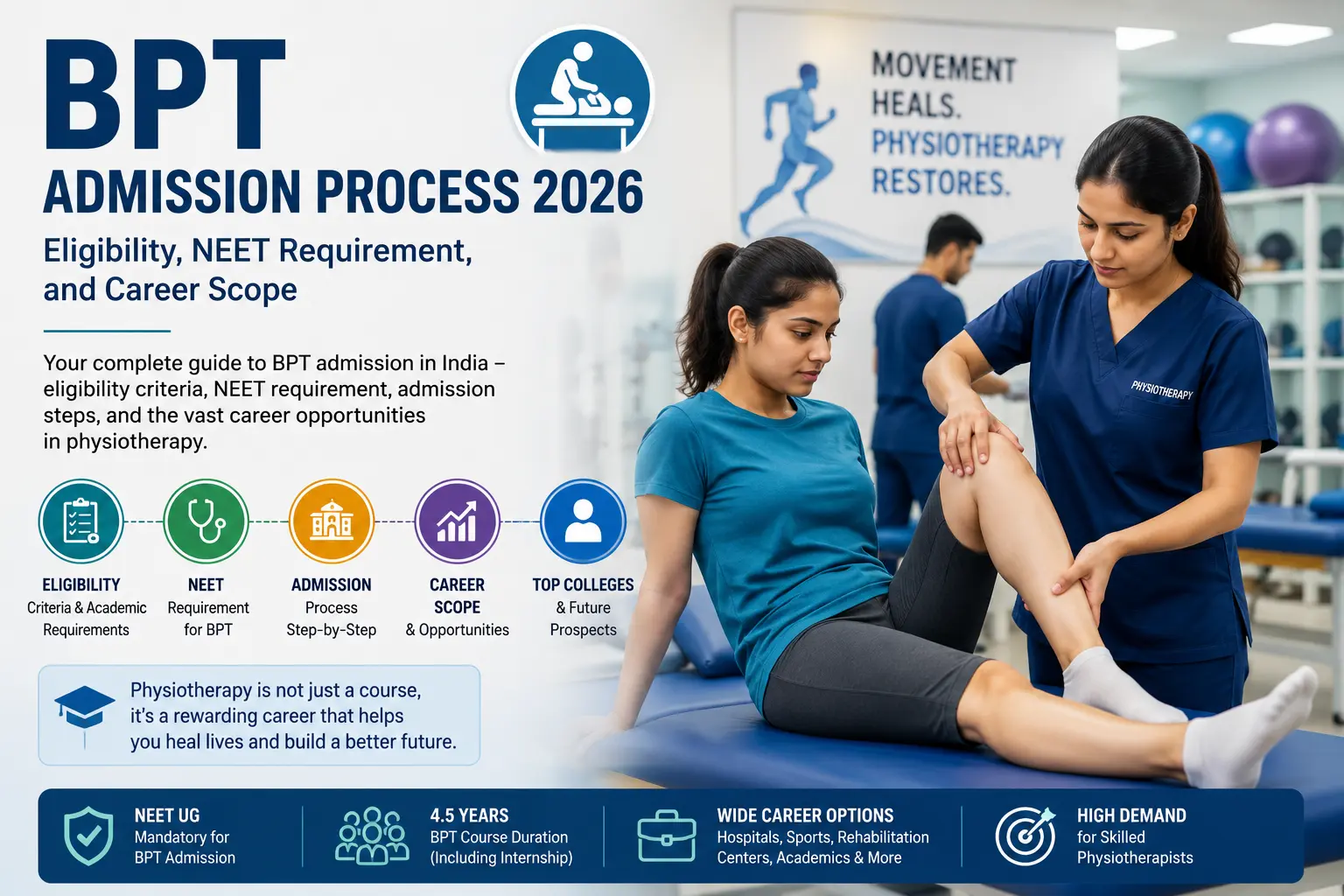
Physiotherapy has quietly become one of the most in-demand allied health careers in India, and the admission rules around it have changed. This guide explains BPT eligibility, the NEET requirement introduced by NCAHP, the full admission process, and where a BPT degree can actually take you.
Physiotherapy used to be seen as a fallback option for students who didn’t get a medical seat. That perception is outdated. With rising awareness of sports injuries, post-surgical rehabilitation, and geriatric care, physiotherapists are now core members of hospital and wellness teams — and the admission process for the Bachelor of Physiotherapy (BPT) course has been tightened accordingly. Here is what the 2026 process actually looks like.
What Is BPT?
BPT is an undergraduate degree that trains students in human anatomy, physiology, biomechanics, and therapeutic exercise, preparing them to help patients recover movement and function after injury, illness, or surgery. It is a professional healthcare degree, not a general science course, which is why the eligibility and regulatory framework around it has grown stricter in recent years.
Eligibility Criteria for BPT
- You must have completed Class 12 with Physics, Chemistry, and Biology (Zoology and Botany).
- You need a minimum of 50% aggregate marks across these three subjects (relaxations may apply for reserved categories, depending on the institution and state).
- You must be at least 17 years old at the time of admission.
Is NEET Mandatory for BPT?
This is the single biggest change students need to know about. The National Commission for Allied and Healthcare Professions (NCAHP) has moved to make NEET UG a mandatory requirement for BPT admissions, phasing out the older system where many colleges admitted students directly on Class 12 merit. In practice, this means most institutions now expect a valid NEET UG attempt, even though NCAHP has not prescribed a specific minimum qualifying score for BPT the way it does for MBBS.
Because implementation timelines and exact requirements can still vary by state and institution, always confirm the current year’s rule directly with your shortlisted colleges before you finalize your exam and application plan.
Step-by-Step Admission Process
- Appear for NEET UG, as most recognized BPT colleges now require it as a baseline qualification.
- Shortlist colleges based on NCAHP/state council recognition, faculty strength, and the quality of their affiliated hospital for clinical training — this last point matters more for physiotherapy than almost any other allied health course, since hands-on hours define your competence.
- Apply through the relevant counseling body — this may be a central/state counseling process or direct application to the university, depending on the state and institution type.
- Participate in institutional counseling or merit-based selection, where seats are offered based on your NEET score and category.
- Complete document verification and pay the admission fee to confirm your seat.
Course Duration and Structure
BPT is a five-year program: four years of academic coursework covering subjects like anatomy, physiology, biomechanics, exercise therapy, and electrotherapy, followed by one compulsory year of clinical internship. The internship year is where classroom learning turns into real clinical judgment, so don’t treat it as a formality — the hospital you intern at matters.
Career Scope After BPT
A BPT degree opens doors far beyond a single job title:
- Clinical physiotherapist in hospitals, private clinics, and rehabilitation centers.
- Sports physiotherapist, working with athletic teams and sports academies.
- Home healthcare and geriatric care physiotherapist, a fast-growing segment as India’s elderly population increases.
- Women’s health and prenatal/postnatal rehabilitation specialist.
- Rehabilitation technology and assistive-device specialist, an emerging niche as wearable and robotic rehab tools become mainstream.
Notably, under recent NCAHP norms, qualified physiotherapists are permitted to use “Dr.” as a prefix and “PT” as a suffix with their name — a recognition of physiotherapy’s growing professional standing.
Choosing the Right College
Because clinical exposure defines the quality of a physiotherapy graduate, prioritize colleges with a strong attached hospital, structured internship placements, and updated equipment for electrotherapy and biomechanics labs over colleges that only look good on a brochure.
Final Word
BPT is no longer a “backup” course — it is a regulated healthcare profession with its own entrance pathway, its own clinical rigor, and a genuinely strong career runway. If you’re evaluating whether BPT, BSc Nursing, or another allied health course fits your strengths better, that comparison is worth doing properly before you commit five years to it.