
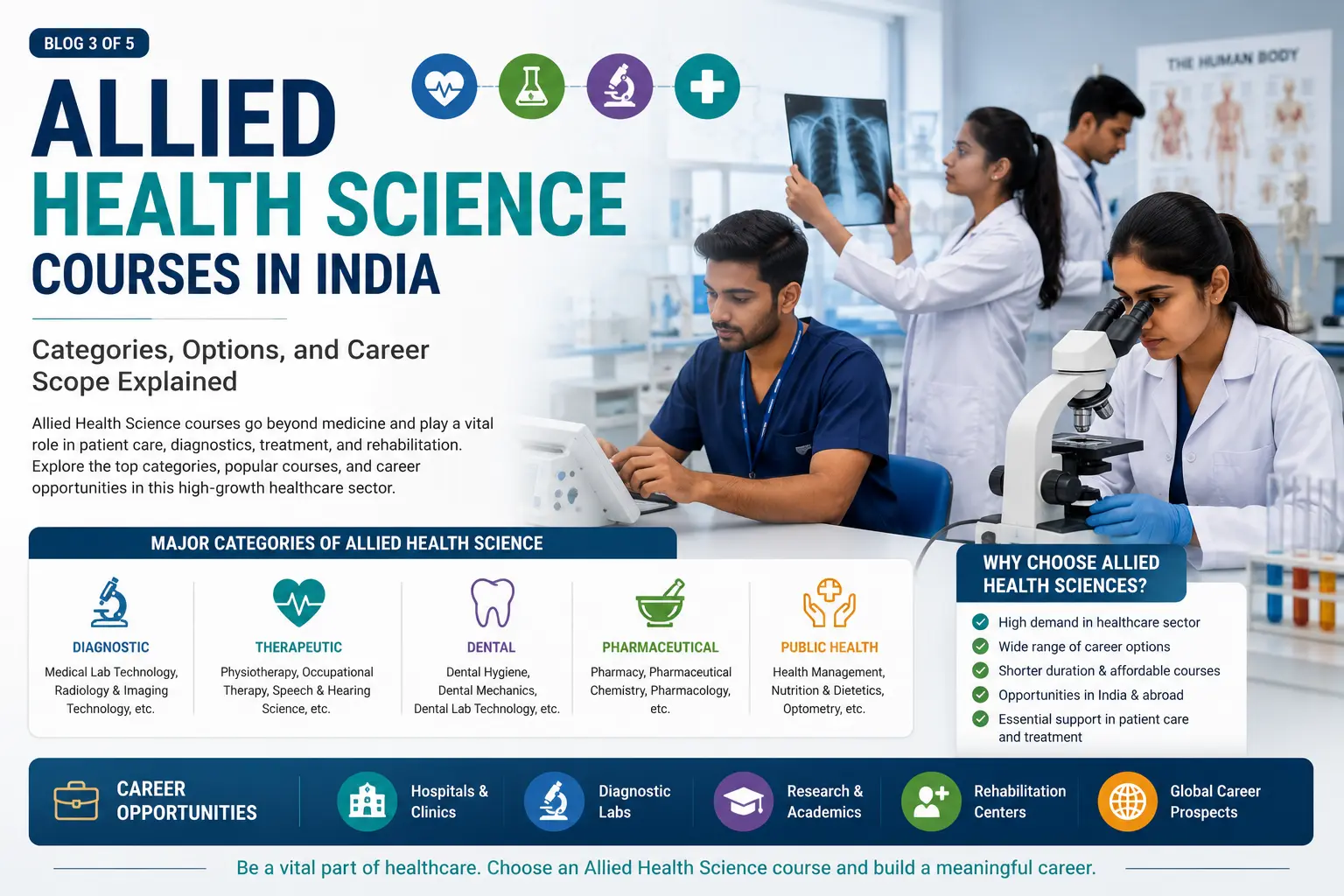
Beyond MBBS and nursing lies a whole universe of healthcare careers most students never hear about until it’s too late to plan for them. This guide maps out the major categories of allied health science courses in India — what each one involves, who it suits, and where it leads.
Ask ten Class 12 science students what career options exist in healthcare, and nine will say “MBBS, BDS, or nursing.” Very few know that hospitals run on a much wider workforce — the technologists, therapists, and technicians who make diagnosis and treatment actually possible. This is the world of allied health sciences, and it is one of the fastest-growing, most underexplored career categories in Indian healthcare today.
What Is Allied Health Science?
Allied health science is an umbrella term for healthcare courses and professions that support diagnosis, treatment, and rehabilitation, but sit outside the traditional doctor-nurse-dentist framework. These professionals often work directly with life-saving equipment and diagnostic processes, making their role in patient outcomes far larger than most students realize.
General Eligibility
Most allied health courses share a common entry requirement: 10+2 (or equivalent) with a minimum of 50% marks in Physics, Chemistry, and Biology or Mathematics. Specific programs may have additional requirements, so always check the individual course page before assuming eligibility.
Major Categories of Allied Health Science Courses
1. Medical Laboratory Technology
Covers diagnostic testing on blood, tissue, and other patient samples. Graduates work as medical lab technologists in diagnostic labs, blood banks, and hospital pathology departments — a role in constant demand given India’s growing diagnostics industry.
2. Radiology and Medical Imaging Technology
Trains students to operate diagnostic imaging equipment such as X-ray, CT, and MRI machines. Radiology technologists are essential in every mid-to-large hospital and increasingly in dedicated diagnostic imaging chains.
3. Physiotherapy
Focuses on physical rehabilitation and restoring patient mobility after injury, surgery, or illness. Available at diploma, BSc, and postgraduate levels, with strong demand in hospitals, sports medicine, and private rehabilitation clinics.
4. Optometry
Covers vision assessment, eye examination, and corrective care. Optometrists work in eye clinics, hospitals, and the rapidly expanding optical retail and eyewear industry.
5. Operation Theatre (OT) Technology
Trains students to assist surgeons, manage surgical equipment, and maintain sterile OT environments. A critical, high-responsibility role that is often underestimated by students choosing their stream.
6. Anesthesia Technology
Prepares technicians to assist anesthesiologists before, during, and after surgical procedures — a specialized and well-compensated niche within hospital operations.
7. Cardiac Care Technology
Focuses on supporting cardiologists with diagnostic and monitoring equipment such as ECG and cath lab procedures, a growing field given India’s rising cardiac care needs.
8. Audiology and Speech-Language Pathology
Covers hearing assessment and speech-language rehabilitation, addressing a segment of patient care — particularly pediatric and geriatric — that is chronically underserved in India.
9. Dialysis Technology
Trains technicians to operate and manage dialysis equipment for patients with kidney disease, a category with rising demand as lifestyle-related kidney disorders increase nationally.
Why This Category Deserves More Attention
Two things make allied health science worth serious consideration. First, the entry barrier is lower than MBBS or BDS but the career stability is comparable, since every hospital, diagnostic center, and clinic structurally depends on these roles. Second, most of these fields are experiencing faster hiring growth than headline medical courses, simply because India is building diagnostic and rehabilitation infrastructure faster than it is producing doctors.
How to Choose the Right Allied Health Course
Match the course to your actual interest rather than picking the first one you hear about. If you enjoy precision, lab work, and diagnostics, medical lab technology or radiology suits you. If you’re drawn to hands-on patient interaction and physical recovery, physiotherapy is the natural fit. If surgical environments interest you without wanting to be the surgeon, OT technology or anesthesia technology are worth exploring.
Final Word
Allied health sciences are not a consolation prize for students who didn’t clear NEET for MBBS — they are a distinct, high-demand career category with their own entrance routes, specializations, and growth trajectories. If you’re a Class 12 student weighing MBBS against allied health options, it’s worth getting a proper comparison of eligibility, cost, and career outcomes before deciding, rather than defaulting to whichever course your friends are choosing.