
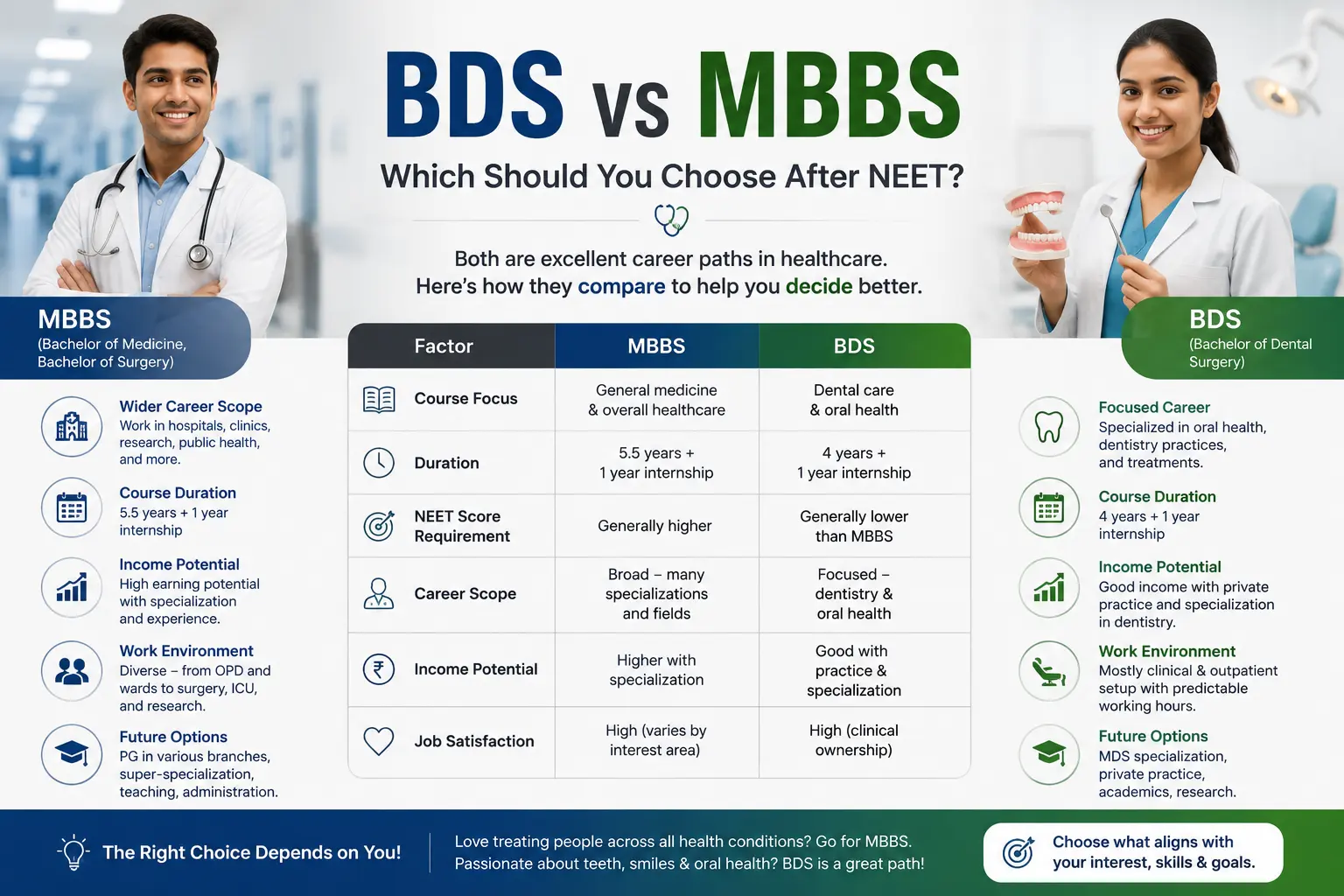
For students whose NEET rank sits in a range where an MBBS seat isn’t guaranteed but a good BDS seat is, this comparison becomes a real, high-stakes decision — not just a theoretical one. Both are respected medical degrees admitted through the same exam, but they lead to very different day-to-day careers. Here’s an honest comparison.
Course Structure and Duration
MBBS is a 5.5-year program, including a mandatory one-year rotating internship, covering the full range of human medicine across all body systems. BDS is a 5-year program, including a mandatory one-year internship, focused specifically on oral health, dentistry, and maxillofacial care.
Scope of Practice
MBBS graduates are trained to diagnose and treat conditions across the entire body and can specialize into virtually any medical or surgical field through postgraduate study. BDS graduates specialize specifically in oral and dental health from the outset — general dentistry, orthodontics, oral surgery, periodontics, and related fields — a narrower but deeply specialized scope.
Postgraduate Pathways
MBBS graduates can pursue NEET PG to specialize into fields ranging from general medicine and surgery to radiology, dermatology, orthopedics, and dozens of other specialties, with significant variation in competitiveness and lifestyle across specialties. BDS graduates pursue NEET MDS to specialize into dental fields such as orthodontics, oral and maxillofacial surgery, prosthodontics, or periodontics — a smaller set of options but generally less competitive at the postgraduate level than medical PG seats.
Career Paths and Work Life
MBBS careers span an enormous range — from a rural general physician to a hospital-based surgeon to a research-focused specialist — with correspondingly varied work hours, on-call demands, and emergency responsibilities depending on the specialty chosen. BDS careers tend to offer more predictable working hours and a higher likelihood of eventually running an independent private practice, since dental clinics require less infrastructure than hospitals, making entrepreneurship a realistic path relatively early in a dentist’s career.
Income Potential
Income for both fields varies enormously based on specialization, location, and whether you work in government service, a private hospital, or independent practice. In general, specialized MBBS postgraduate fields — particularly surgical and diagnostic specialties — tend to have a higher income ceiling than general dentistry, but well-established dental specialists and successful independent dental practices can also be highly lucrative, especially in urban markets where cosmetic and specialized dentistry demand is rising.
Seat Availability
MBBS seats are significantly fewer relative to NEET applicant numbers, making the cutoff considerably higher than BDS. BDS seats, while still competitive, generally have a lower cutoff, meaning a rank that doesn’t secure a reasonable MBBS seat may still secure a good BDS seat at a well-regarded institution.
How to Decide
If your rank comfortably secures a decent MBBS seat, that additional scope and postgraduate flexibility generally makes it the stronger default choice for most students. If your rank only secures a mediocre MBBS seat at a college with weak infrastructure, but a strong BDS seat at a reputable dental college, the BDS option often provides better long-term training quality — a distinction students frequently underweight when chasing the MBBS label itself over actual college quality.
Beyond rank, consider your actual interest: if precision, fine motor work, and a narrower daily scope genuinely appeal to you, dentistry can be a deeply satisfying and less physically taxing long-term career than many surgical medical specialties.
Final Word
Neither MBBS nor BDS is a “consolation” choice — they’re two distinct professional paths with different scopes, lifestyles, and growth trajectories. Choosing based on college quality and genuine interest, rather than defaulting to whichever carries more social prestige, tends to lead to better long-term career satisfaction either way.