
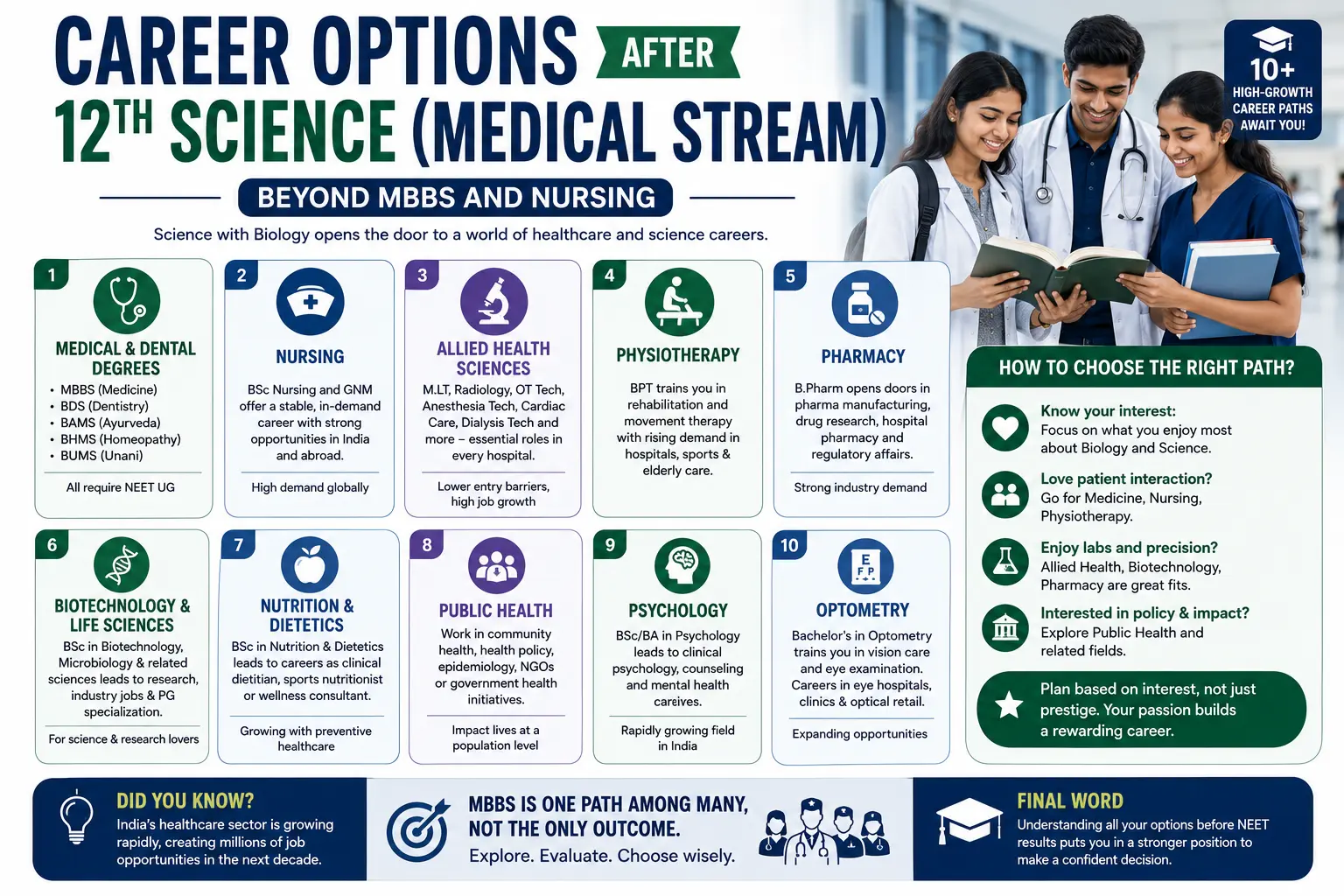
Every year, a huge number of Class 12 Biology students narrow their entire career plan down to one word: MBBS. When that doesn’t work out — or even before NEET results are out — most students don’t know what else exists. The truth is, a Science background with Biology opens up a wide range of legitimate, well-paying healthcare and science careers. Here’s a realistic map of the options.
Medical and Dental Degrees
The most well-known routes remain MBBS (medicine) and BDS (dentistry), both requiring NEET UG. Alongside these, BAMS (Ayurveda), BHMS (Homeopathy), and BUMS (Unani) are recognized medical degrees with their own licensing pathways and a growing role in India’s integrated healthcare system, all admitted through NEET UG as well.
Nursing
BSc Nursing and GNM offer a globally in-demand, relatively fast route into a stable healthcare career, with strong opportunities both within India and internationally, particularly in the Gulf, UK, and other regions facing nursing shortages.
Allied Health Sciences
This is the most underexplored category, covering fields like medical laboratory technology, radiology and imaging technology, operation theatre technology, anesthesia technology, cardiac care technology, and dialysis technology. These roles are essential to every hospital’s day-to-day functioning, generally have lower entry barriers than MBBS, and are seeing faster hiring growth as India expands its diagnostic and hospital infrastructure.
Physiotherapy
BPT (Bachelor of Physiotherapy) trains students in rehabilitation and movement therapy, with growing demand across hospitals, sports medicine, and elderly care as awareness of physical rehabilitation increases across India.
Pharmacy
A B.Pharm degree opens doors into pharmaceutical manufacturing, drug research, hospital pharmacy, and regulatory affairs — a field with strong demand given India’s position as a major global pharmaceutical manufacturer.
Biotechnology and Life Sciences
A BSc in Biotechnology, Microbiology, or a related life science leads toward research roles, biotech and pharma industry jobs, and further postgraduate specialization, appealing to students who enjoy the science itself more than direct patient care.
Nutrition and Dietetics
A BSc in Nutrition and Dietetics leads to roles as a clinical dietitian in hospitals, a sports nutritionist, or a wellness consultant — a growing field as preventive healthcare and lifestyle-related disease awareness increases in India.
Public Health
A degree in Public Health prepares students for roles in community health programs, health policy, epidemiology, and NGO or government health initiatives — a meaningful path for students interested in population-level impact rather than individual patient care.
Psychology
A BSc or BA in Psychology, often open to Science stream students, leads toward clinical psychology, counseling, and mental health careers — a rapidly growing field in India as mental health awareness increases.
Optometry
A Bachelor’s in Optometry trains students in vision care and eye examination, with career opportunities in eye hospitals, clinics, and the expanding optical retail industry.
How to Choose Among These Options
Start with what you actually enjoy about Biology and Science, not just which course sounds most prestigious. If you’re drawn to direct patient interaction, nursing, physiotherapy, or medicine fit best. If you enjoy precision, lab work, and diagnostics, allied health or biotechnology are strong fits. If you’re interested in the business and policy side of healthcare, public health or healthcare administration-adjacent degrees are worth exploring.
Final Word
MBBS is one respected path among many, not the only legitimate outcome of a Science education. Understanding the full range of options — and their real eligibility, cost, and career trajectories — before NEET results even arrive puts you in a far stronger position to make a confident decision instead of a rushed one.