
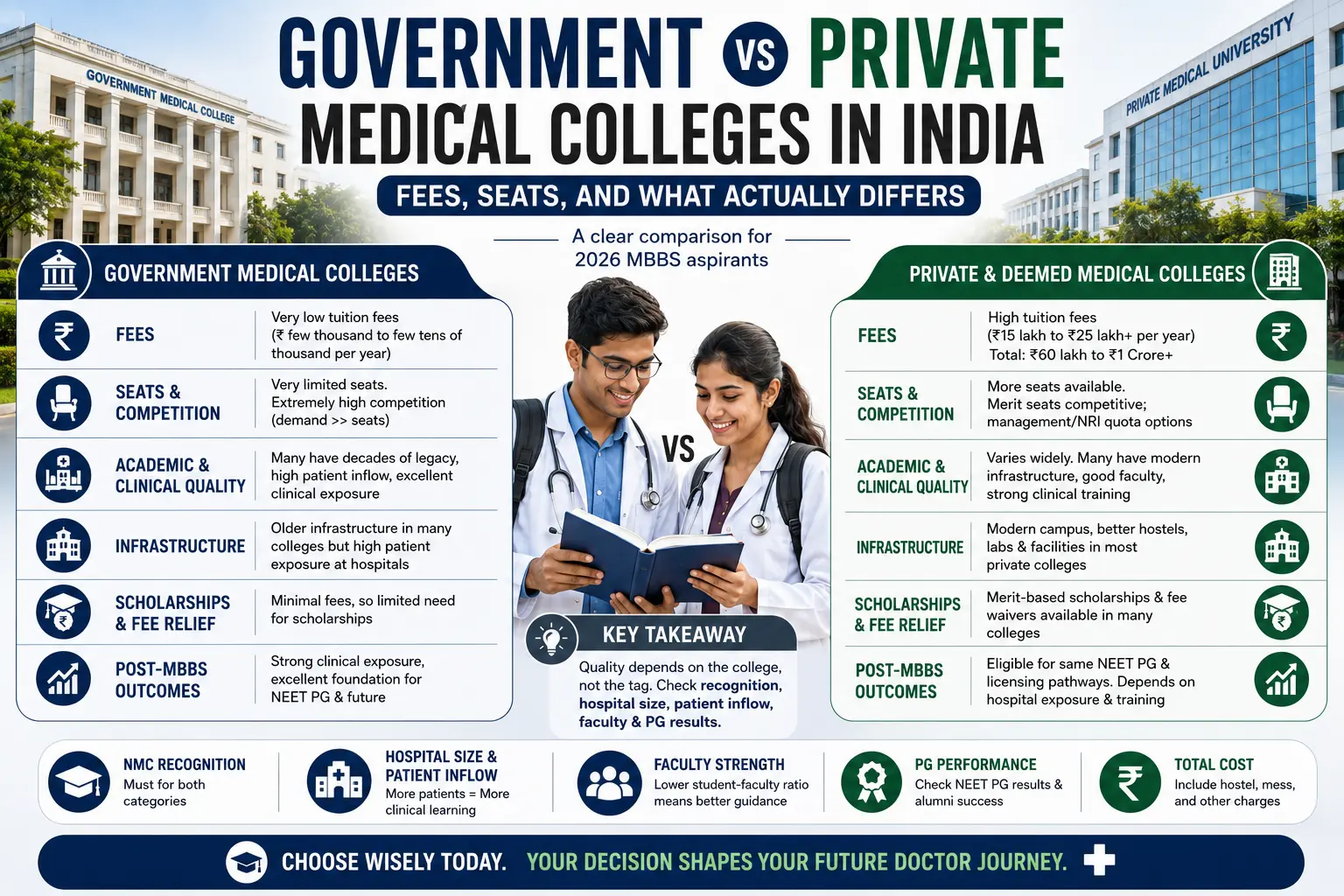
For most NEET aspirants, the government-versus-private medical college question comes down to one number: the fee difference, which can run into tens of lakhs of rupees. But fees are only part of the picture. Here’s an honest comparison of what actually differs between the two, beyond the obvious cost gap.
The Fee Gap Is Real — and Large
Government medical colleges in India charge tuition that is typically a few thousand to a few tens of thousands of rupees per year, making the full MBBS course cost a small fraction of the private route. Private and deemed university MBBS seats, on the other hand, commonly range from roughly ₹15 lakh to over ₹25 lakh per year depending on the institution and quota, pushing the total course cost into the ₹60 lakh to over ₹1 crore range at many private and deemed institutions. This is by far the single biggest differentiator between the two paths.
Seat Availability and Competition
Government medical college seats are far more competitive relative to their numbers because demand vastly outstrips the limited government seat count nationally. Private and deemed medical colleges collectively account for a significant share of India’s total MBBS seats, and while merit-based seats are still competitive, management and NRI quota seats offer a path in at a higher fee for candidates with somewhat lower NEET ranks.
Academic and Clinical Quality: It’s Not a Blanket Rule
It’s a common assumption that government colleges are automatically better academically. In reality, quality varies significantly within both categories. Many of India’s oldest and most respected government medical colleges have decades of teaching hospital experience and very high patient volumes, giving students exceptional real-world clinical exposure. At the same time, several well-established private and deemed universities have invested heavily in large attached hospitals, modern infrastructure, and strong faculty, and are considered on par with or above many government colleges in specific specialties. Judge each college on its NMC recognition status, hospital bed count and patient inflow, and faculty strength — not on the government-vs-private label alone.
Infrastructure and Campus Facilities
Private colleges generally invest more heavily in visible infrastructure — hostels, labs, campus facilities — since this is a key part of their pitch to fee-paying students. Government colleges, especially older ones, may have less polished infrastructure but often compensate with higher patient volumes at their attached hospitals, which directly translates to more hands-on clinical learning.
Scholarships and Fee Relief
Government colleges have minimal fees to begin with, so scholarship dependence is low. Many private and deemed universities do offer merit-based fee waivers or scholarships for top NEET rankers, which can meaningfully reduce the cost gap for high-scoring students — always check a shortlisted private college’s current-year scholarship policy directly rather than assuming none exists.
Post-MBBS Outcomes
Both government and reputed private college graduates are eligible for the same NEET PG and licensing pathways, and ultimately, PG entrance performance and residency quality matter more to long-term career outcomes than which category of college you graduated from. That said, colleges with larger, busier attached hospitals — government or private — tend to produce graduates with stronger hands-on clinical confidence heading into internship and PG training.
How to Actually Decide
If your NEET rank comfortably secures a reputable government seat, that is almost always the financially rational choice. If your rank falls short of government seats but you can genuinely afford a private or deemed seat without financial strain, prioritize colleges with strong NMC recognition, large attached hospitals, and a track record of PG entrance and licensing success — not just brand recognition or campus photos.
Final Word
The government-versus-private decision is rarely just about fees — it’s about matching your rank, budget, and risk tolerance to a college that will actually give you strong clinical exposure. If you’re weighing a specific private college’s fee structure against your rank and government seat chances, that comparison is worth running properly before you commit lakhs of rupees to a decision.