
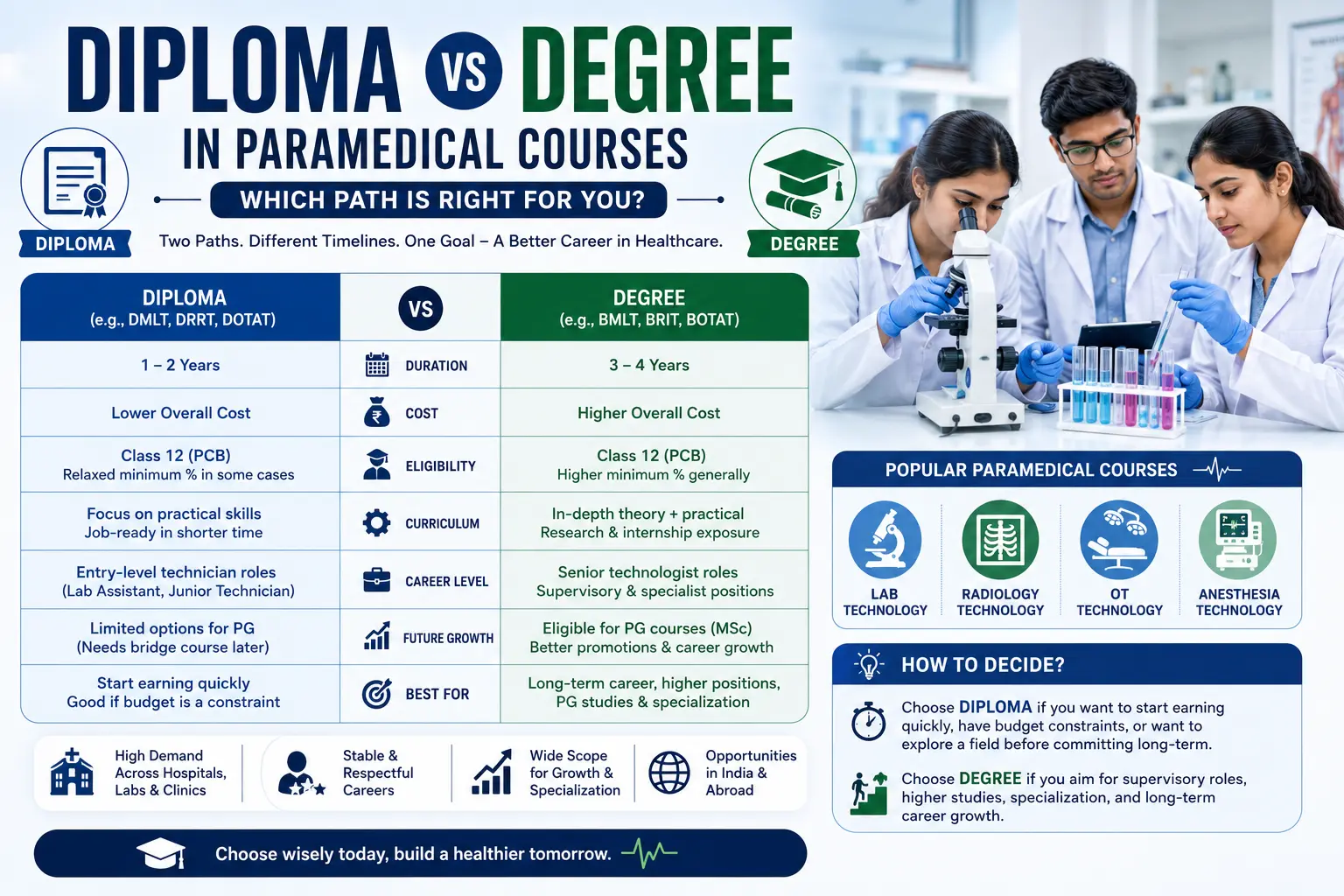
Almost every paramedical field in India — lab technology, radiology, OT technology, anesthesia technology — offers both a diploma and a degree version of the same course. Students often pick based on which one their neighborhood college offers, without realizing the two paths lead to meaningfully different career ceilings. Here’s how to actually choose.
What’s the Core Difference?
A diploma paramedical course (for example, DMLT — Diploma in Medical Laboratory Technology) is typically a 2-year program focused on practical, job-ready skills with minimal theoretical depth. A degree course (for example, BMLT — Bachelor in Medical Laboratory Technology) is typically a 3 to 4-year program that covers the same practical skills but adds substantially more theory, research exposure, and often a structured internship component.
Duration and Time Investment
Diplomas generally take 1 to 2 years, making them the faster route to entering the workforce. Degree programs generally take 3 to 4 years, including internship, representing a longer but more comprehensive investment.
Eligibility
Both diploma and degree paramedical courses generally require Class 12 with Physics, Chemistry, and Biology, though some diploma programs have slightly more relaxed minimum percentage requirements than their degree equivalents. Always verify the specific eligibility for your chosen specialization and state, since requirements differ by course.
Cost Comparison
Diploma courses are generally more affordable and quicker, which makes them attractive if your priority is starting to earn as soon as possible. Degree courses cost more overall due to the longer duration, but often deliver better long-term value through higher starting designations and stronger promotion potential.
Career Scope: Where the Real Difference Shows Up
This is the most important distinction. Diploma holders are typically eligible for entry-level technician roles — for example, a lab assistant or junior technician position. Degree holders are typically eligible for more senior technologist roles, supervisory positions, and are far better positioned for further postgraduate study, since most MSc-level paramedical programs require a bachelor’s degree as a prerequisite, not a diploma.
In practice, many diploma holders eventually pursue a lateral-entry or bridge program into the degree track later in their career specifically to unlock supervisory roles and postgraduate study — so if you can afford the extra one to two years upfront, it often saves you from having to circle back later.
Job Market Reality
Both diploma and degree holders are employable across diagnostic labs, hospitals, and imaging centers, and entry-level hiring doesn’t always distinguish sharply between the two. The gap widens over time — as professionals gain experience, degree holders tend to move into supervisory, quality-control, or training roles faster, while diploma holders without further qualification often plateau at the technician level.
How to Decide
Go for a diploma if you need to start earning quickly, have budget constraints, or want to test whether a specific paramedical field genuinely interests you before committing to a longer degree.
Go for a degree if you’re aiming for supervisory roles, considering postgraduate study down the line, want a stronger foundation for specialization, or are applying to fields like anesthesia technology and OT technology where degree-holders are increasingly preferred by larger hospitals.
Final Word
There’s no universally “right” choice between diploma and degree paramedical courses — it depends on your timeline, budget, and how far up the career ladder you eventually want to climb. What matters is choosing deliberately rather than defaulting to whichever course your local college happens to offer.